Six objectives for a successful capacity market in Czechia
Obsah
Czechia needs to urgently replace its retiring coal fleet to avoid grid reliability issues after 2030. To attract investment in backup power plants, the government is designing a capacity market under the EU's new fast-track framework (CISAF). As the first country to implement these rules, Czechia has a unique design challenge. This policy paper outlines six essential objectives to ensure this new market delivers great value for money and limits long-term gas dependency.
Problem: Resource Inadequacy and the “Missing Money”
The rapid growth of wind and solar power across Europe is successfully driving down carbon emissions, but it is also disrupting traditional energy markets. In Czechia, this transition is reaching a critical tipping point. The country still relies heavily on coal, which supplied nearly 40% of its electricity in 2024. However, rising carbon costs and cheap renewable imports are rendering domestic coal plants financially unviable, pushing them to close much faster than expected.
While weather-dependent renewables are expanding across Europe, Czechia still needs backup from dispatchable power sources (like gas plants or batteries) to maintain resource adequacy and meet peak demand when renewable generation is low. Building these backup facilities is expensive and highly risky for investors. In theory, electricity prices should spike during power shortages to reward backup plants for running. In practice, governments often cap prices to protect consumers. This creates a systemic “missing money” problem: investors cannot make enough profit from the energy market alone to justify building new assets.
Consequently, Czechia is failing to replace its retiring coal plants, threatening grid reliability. Official forecasts (ERAA 2025) warn that by 2030, Czechia’s Loss of Load Expectation (LOLE) could reach 18 to 29 hours per year – meaning the grid will face hours where available power supply cannot safely meet demand. This is three to four times higher than the national reliability standard, making market intervention urgent.
Tool to Help: Capacity Market
Introduction to capacity markets
The basic principles of capacity markets are covered in our explainer (in Czech).
To secure energy supplies and boost investments, a growing number of EU countries – including the UK, France, and Poland – have introduced capacity markets. Instead of paying producers only for the electricity they deliver, a capacity market pays them simply to be ready to provide power when the grid is under strain.
Under this competitive system, power providers bid in auctions several years in advance. Winning bidders receive fixed annual payments funded by consumer grid tariffs. This long-term financial certainty drastically reduces risk for developers, successfully driving the construction of new infrastructure. To accelerate these efforts, in 2025 the European Commission introduced the CISAF framework (Clean Industrial Deal State Aid Framework), which fast-tracks approvals for countries following a set of pre-defined design rules.
Policy Recommendations: Six Objectives for a Successful Capacity Market in Czechia
Czechia is currently designing its own capacity market under CISAF to incentivise immediate investment in new, reliable power sources. This policy brief identifies six objectives across three focus areas to guide Czechia toward a successful, cost-effective capacity market:
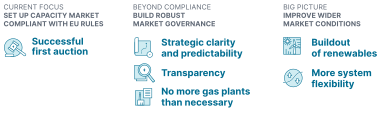

Successful first auction, guaranteeing that the market delivers on its core goals: building new capacity at a reasonable cost. This is no trivial task, as CISAF is a very complex policy tool and Czechia is the first country establishing a capacity market according to its design rules.

Strategic clarity and predictability. The market should be anchored in strategic goals with clear, measurable objectives against which performance can be regularly assessed.

Transparency. Assumptions, data, and methodologies should be transparent and subject to independent expert scrutiny. This guards against the well-documented tendency of system operators to overestimate capacity needs. Furthermore, derating factors must be defined transparently rather than arbitrarily, as has occurred in Poland.

No more gas plants than necessary. Steps must be taken to prevent the overbuilding of gas capacity. An excessive gas buildout risks locking substantial capital into a technology that could quickly become outdated and economically unviable to run.

Buildout of renewables. Czechia must speed up the rollout of renewables to limit the power sector’s gas dependency during the 2030s – a dependency that the capacity market will unfortunately increase. Both solar and wind power are crucial to minimise the role of gas. Less reliance on gas translates to cheaper electricity that is far less exposed to gas and ETS1 price volatility.

More system flexibility. Improving the flexibility of the Czech power system is not an abstract, long-term objective. Real demand-side flexibility delivered before 2030 can substantially decrease capacity market costs. Achieving this requires an accelerated rollout of smart meters, dynamic network tariffs, and additional support schemes to develop the market of flexibility aggregation.